The Hague Hosts Discussion on the International Accountability Framework for Russia’s Crimes Through the Lens of Mariupol
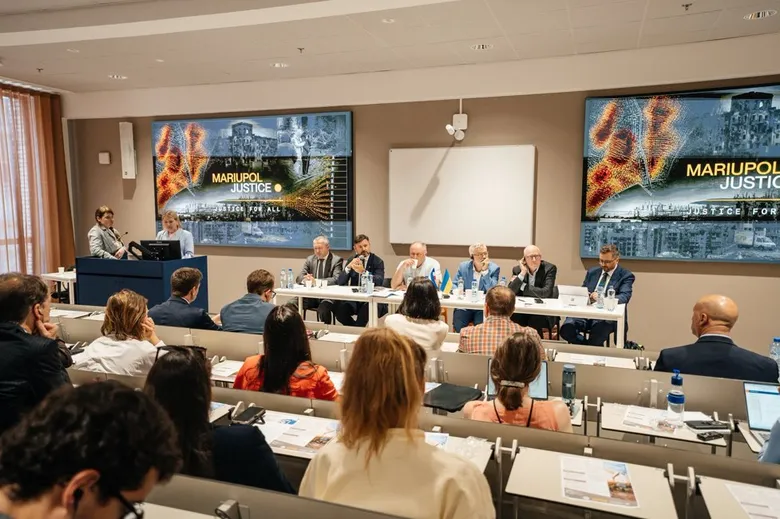
On 23 June, The Hague hosted the public discussion “Restoring Justice for Ukraine Through the Lens of Mariupol” as part of the global human rights initiative Mariupol Justice. Organized by the Mariupol City Military Administration with the support of the Embassy of Ukraine in the Kingdom of the Netherlands and the Rinat Akhmetov Foundation, the event brought together representatives of international legal institutions, the diplomatic community, experts, and members of the Ukrainian community to discuss mechanisms for holding Russia accountable for war crimes and crimes committed against civilians.
Today, Mariupol stands as one of the most widely recognized symbols of Russia’s aggression against Ukraine and one of the most extensively documented cases of crimes committed against a civilian population. For this reason, the city’s experience served as the foundation for a broader international discussion on justice, accountability, and the protection of the international legal order.
For the people of Mariupol, and for me personally, it is essential that the truth is heard. The world must know the truth about the tragedy of Mariupol, see the true face of this war, and recognize Russia’s aggression against our city. When Mariupol was still under siege, President Volodymyr Zelenskyy said that Mariupol was the heart of Ukraine. I sincerely hope that through justice this heart will continue to beat — for our freedom, our independence, and for the truth we are sharing here today, said Head of the Mariupol City Military Administration and Mayor of Mariupol Vadym Boichenko.
One of the central topics of the discussion was the establishment of a Special Tribunal for the Crime of Aggression against Ukraine. Participants noted that the international community has come close to completing the legal framework necessary for launching this mechanism.
Fighting impunity and ensuring compensation for damages are essential elements of a just and lasting peace. The creation of institutions to respond to Russian aggression has already passed the point of no return, and the Netherlands remains committed to supporting Ukraine in securing accountability at both the international and national levels, said Arjen Uijterlinde, Special Envoy for the Special Tribunal for the Crime of Aggression against Ukraine at the Ministry of Foreign Affairs of the Netherlands.
Speakers emphasized that the international justice system is approaching the creation of a mechanism that could, for the first time in decades, hold a state’s highest political and military leadership accountable for the crime of aggression. The historic significance of this process for international law was highlighted by Professor of Criminal Law and Public International Law at the University of Cologne, Claus Kress.
We have effectively reached the point of no return in establishing the legal foundation for the international prosecution of the crime of aggression — the first effort of its kind since Nuremberg and Tokyo. It is the result of a complex compromise, but the key task now is to secure the political will to complete the process and ensure the broadest possible international legitimacy for the tribunal, he noted.
At the same time, the creation of international accountability mechanisms would not be possible without large-scale efforts to document crimes. In this regard, Mariupol remains one of the largest repositories of evidence of Russian crimes against civilians.
Thousands of crimes committed in Mariupol are currently under investigation. Among them are more than 6,500 alleged war crimes, including wilful killings, torture, sexual violence, forced deportations, and attacks against civilians and civilian infrastructure. The scale is so vast that it is difficult to identify an international crime that was not committed there, said Andrii Kostin, Ambassador Extraordinary and Plenipotentiary of Ukraine to the Kingdom of the Netherlands.
Work is also continuing on a compensation mechanism designed to provide redress to those affected by Russian aggression. One of its key components is the Register of Damage for Ukraine.
This mechanism is already operational. More than 165,000 claims have been submitted by people affected by Russian aggression, including nearly 30,000 from Mariupol residents. Behind every claim stands a human tragedy and a person’s right to justice and compensation, said Markiyan Kliuchkovskyi, Executive Director of the Register of Damage Caused by the Aggression of the Russian Federation against Ukraine.
Behind the statistics, legal mechanisms, and international decisions are real human stories. Participants were reminded of the human cost of Russia’s aggression by Andrii Servetnyk, Chief Physician of Mariupol City Hospital No. 4, who remained in the city during the siege in the spring of 2022 and continued to save lives under constant shelling.
The Russians spared no one. They systematically attacked the city and killed its residents. They deliberately targeted civilians. I witnessed it with my own eyes — elderly people, young people, women, men, children. Every story matters. Documenting crimes in every form — on websites, in official records, and through testimonies — is critically important so that nothing is lost, forgotten, or manipulated in the future; so that future generations know the truth about this war and justice can ultimately be restored, said Andrii Servetnyk, whose story is featured in the Rinat Akhmetov Foundation’s Museum of Civilian Voices.
Mariupol Justice is a global human rights initiative focused on documenting crimes, advancing international advocacy, and promoting accountability mechanisms for crimes committed by Russia against Ukraine. Its mission is to ensure that the destruction of Mariupol is recognized, properly documented, and assessed within the framework of international law.
READ ALSO:
Mariupol Justice presented in Brussels as the first international model for restoring justice to a war-affected Ukrainian city
European Parliament calls for recognition of Mariupol’s destruction as a deliberate crime against humanity and presents justice recovery initiative