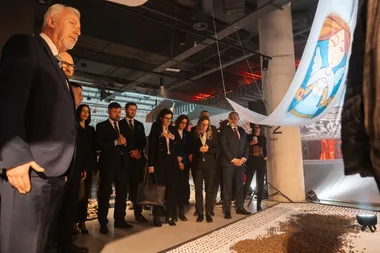
European dimension of accountability: Mariupol Justice presented at the Council of Europe
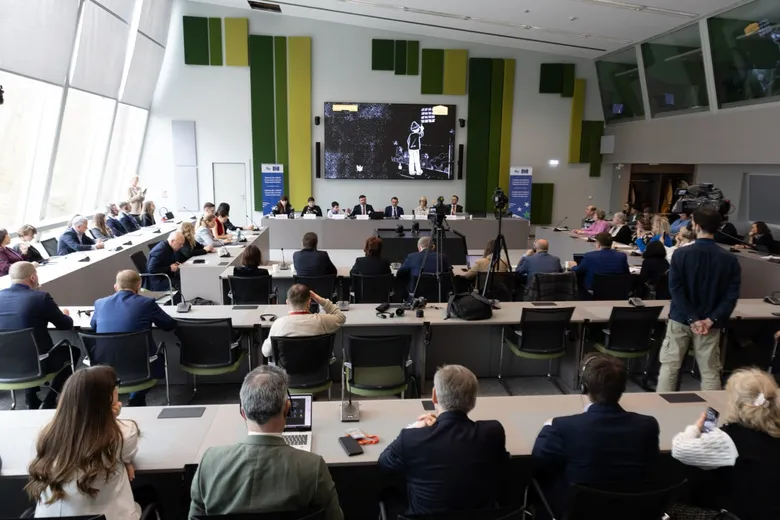
On April 1 in Strasbourg, as part of the 50th session of the Congress of Local and Regional Authorities of the Council of Europe, a special event titled “The European Municipal Dimension of Accountability: The Mariupol Justice Initiative” took place.
The event became a platform where the issue of Mariupol was, for the first time, systematically framed as part of the European agenda not merely as a wartime tragedy, but as a case requiring legal assessment and international accountability.
At the center of the discussion was the Mariupol Justice initiative, which combines crime documentation, eyewitness testimonies, damage assessment, and international advocacy to hold Russia accountable for the destruction of the city.
Mayor of Mariupol and Head of the Mariupol City Military Administration, Vadym Boichenko, emphasized that restoring justice for the city’s residents must come first. According to him, thousands of eyewitness accounts have already been recorded, at least 12,500 civilian deaths have been confirmed, and the total damage is estimated at over €14 billion.
“We must speak the truth out loud. We are here to tell the truth about the tragedy of Mariupol through documenting crimes and to tell it through those who lived it, who know firsthand, not by hearsay, about torture, killings, and abductions carried out by the Russian Federation. It is around justice for Ukraine that we are building a coalition of international partners. I want the Congress of the Council of Europe to become the place where a coalition for justice for Ukraine is formed a coalition capable of holding Russia accountable for all crimes committed against the Ukrainian people,” said the Mayor of Mariupol and Head of the Mariupol City Military Administration.
Accountability for crimes committed against Mariupol is increasingly moving onto the agenda of European institutions. This is not only about supporting Ukraine it is about Europe’s ability to respond to violations of international law and to uphold justice as a foundation of security.
“Mariupol is not only about destruction it is also about resilience and resistance. It is a city that has endured the devastation of its infrastructure and grave human rights violations. That is why its tragedy matters. This is not just evidence it is a moral foundation for the international community and for Ukraine’s recovery. Europe is where accountability must be ensured. This is where key international mechanisms are taking shape: a damage register is being established, a comprehensive compensation mechanism is being developed, and we are moving toward the creation of a special tribunal for the crime of aggression. And we have the capacity to make this happen,” said Mykola Tochytskyi, Ambassador and Permanent Representative of Ukraine to the Council of Europe.
In this context, the local level becomes a crucial part of the system, as communities are the first to document the consequences of war, work directly with people, and shape the demand for justice.
Vice-President of the Congress of Local and Regional Authorities of the Council of Europe and President of the Chamber of Regions, Cecilie Dahlman Eek, emphasized the importance of Europe’s involvement in these efforts:
“Ukraine is the number one priority for the Congress. Mariupol has become a stark reminder of how quickly progress can be destroyed a city that was once rapidly developing is now devastated by war and occupation. But thanks to the resilience of its people and international support, it will rise again. A damage register is already being established as a foundation for justice, and a claims commission will soon begin its work. At the same time, significant progress has been made toward creating an international tribunal for the crime of aggression. This is a crucial step toward accountability and restoring justice. And I want to assure you: this remains among our highest priorities.”
Particular attention was given to building an international system for compensation and accountability. This includes mechanisms that are already operational, as well as those still under development at the European level most notably, the International Register of Damage caused by Russia’s aggression against Ukraine (RD4U).
Markiian Kliuchkovskyi, Executive Director of RD4U, noted that to date, 136,000 claims have been submitted to the register, including more than 25,000 from Mariupol residents – the highest number among Ukrainian communities.
“The Register of Damage for Ukraine, as part of the international compensation mechanism, is a key element of the broader accountability system. There are 16 categories of damage covering different types of loss – loss of life, injuries, sexual violence, forced displacement, loss of housing and businesses. In total, 43 categories are предусмотрені for submission to the Register and eligibility for compensation. We are not only collecting claims we are already verifying them. Looking at Mariupol alone, we have nearly 25,000 claims from this one city. These include loss of homes, loss of life, torture, deportations. This is not only Mariupol’s story it is the story of many cities. Mariupol can become a pilot case demonstrating how this mechanism works,” said Markiian Kliuchkovskyi.
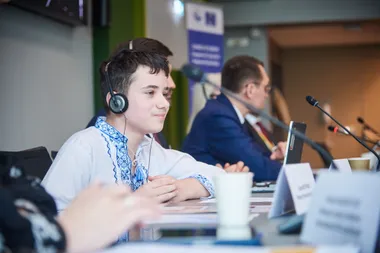
One of the key focuses of the event was personal stories testimonies from those who survived the siege of Mariupol. In particular, the story of Illia Matviienko was shared – a boy who survived injury, the loss of his mother, and forced deportation, but was ultimately able to return and feel safe again with his family.
“Shelling started. A missile hit a nearby building, and fragments struck my legs, while my mother was hit in the head. She died the next day. Later that same day, Russian forces arrived and deported me to Novoazovsk, and then to Donetsk. By sharing our stories, we remind Europe not to forget that we exist that there is a major problem in the form of Russia and everything it is doing to Ukraine,” said Mariupol resident Illia Matviienko.
His experience has become part of the evidence base shaping the understanding of the scale of crimes against civilians. A key role in this process is played by a partner of the Mariupol Justice initiative – the Rinat Akhmetov Foundation, which has been systematically collecting and preserving testimonies of people affected by the war for many years. Its “Voices of Civilians” archive already contains thousands of stories that form the foundation for documenting war crimes.
Bringing these efforts together makes it possible to move from individual testimonies to a systematic approach building an evidence base that can be used in international court proceedings and compensation mechanisms.
This is the core logic of Mariupol Justice: from documenting crimes to their international recognition, from testimonies to legal decisions, from truth to fair compensation for victims.
Participants emphasized that without this sequence, it is impossible to speak of restoring trust or ensuring long-term security in Europe. In this context, the Mariupol Justice initiative stands as a pilot European case for justice.
Background: Mariupol Justice is a global human rights initiative led by the Mariupol City Council in partnership with Ukrainian and international organizations. The project combines documentation of war crimes, eyewitness testimonies, damage assessment, and international advocacy to hold Russia accountable for the destruction of Mariupol.
READ ALSO:
“By sharing our stories, we remind Europe that we exist.” Mariupol resident Illia Matviienko testified at the Council of Europe

The exhibition “Mariupol. The Path of Memory and Dream” was presented live during the national telethon broadcast