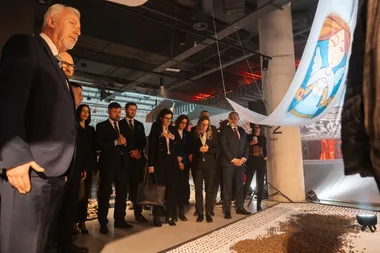
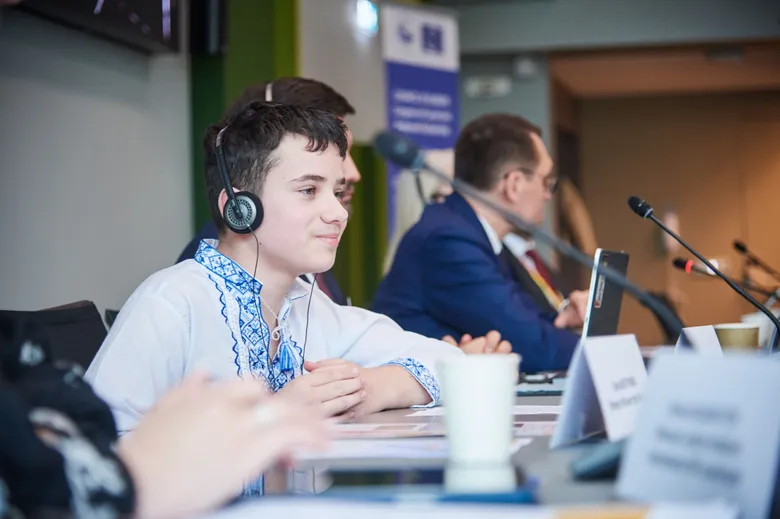
“By sharing our stories, we remind Europe that we exist.” Mariupol resident Illia Matviienko testified at the Council of Europe
More than 19,500 Ukrainian children have been deported. Thousands are believed to have been taken from Mariupol alone. Due to the actions of the aggressor state, it is currently impossible to determine the exact number.
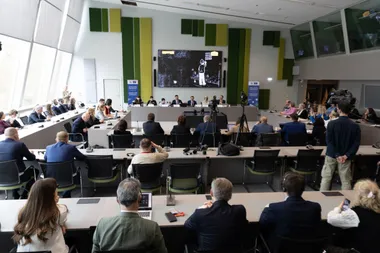
At the level of the Council of Europe in Strasbourg, the issue of deported Ukrainian children was raised as one requiring concrete action both their return and holding Russia accountable.
In this context, the Mariupol Justice initiative was presented a global human rights project that works with evidence and builds the foundation for international legal proceedings.
Council of Europe Commissioner for Human Rights Michael O’Flaherty emphasized:
“We cannot achieve lasting peace without accountability, and we must not sacrifice justice for the sake of a superficial peace. That is why a tribunal for the crime of aggression is so important, and I will continue to fully support it”
At the core of building the evidence base are testimonies from people who survived the siege, lost loved ones, or were injured or deported. At the Council of Europe, Mariupol resident Illia Matviienko shared his story the first child to be successfully returned from occupation after deportation.
“There was shelling. A missile hit a nearby building shrapnel struck my legs, and my mother was hit in the head. She died the next day. Later that day, Russian forces came and deported me to Novoazovsk, and then to Donetsk. By sharing our stories, we make sure Europe doesn’t forget that we exist that there is a very real threat in Russia and everything it is doing to Ukraine,” said Mariupol resident Illia Matviienko.
A key role in documenting testimonies is played by a partner of the Mariupol Justice initiative the Rinat Akhmetov Foundation, which has been systematically collecting and preserving the stories of people affected by the war for many years. Its “Voices of Civilians” Museum has already gathered 145,000 such accounts.
Bringing these efforts together makes it possible to move from individual testimonies to a systematic approach:
recording crimes ➡ international recognition ➡ legal decisions ➡ fair compensation for victims
READ ALSO:
European dimension of accountability: Mariupol Justice presented at the Council of Europe

The exhibition “Mariupol. The Path of Memory and Dream” was presented live during the national telethon broadcast